 Get fees on WhatsApp
Yes, provided the university is UGC-entitled for that programme in your intake year. An entitled online BCA is treated as equivalent to the campus degree for government recruitment, PSU roles and further study. The approval status of every university on this page is stated on its own profile.
All about Online BCA: fees, eligibility, admission, syllabus, specialisations and placements
An BCA online in India costs anywhere from ₹23,700 to ₹1,75,000 for the full 3 years — a spread of roughly 7x for the same UGC-entitled qualification, which is the single most useful thing to know before you shortlist. We track 13 universities offering the Bachelor of Computer Applications in online or distance mode, the lowest published total being IGNOU at ₹23,700. Across them there are 13 distinct specialisations, so the real decision is not "which university" but "which specialisation, at a fee I can finish paying". Eligibility is 10+2 from any recognised board for almost every university here, with no entrance test in the majority of cases.
- Fee range
- ₹23,700 – ₹1,75,000
- Duration
- 3 years
- Eligibility
- 10+2 or equivalent
- Universities
- 13
Fees and eligibility last verified on 2026-08-15 against the university's official pages.
Online BCA fees: lowest published totals
Total programme fee as published by each university. Sorted cheapest first.
| University | Total fee | EMI from |
|---|---|---|
| IGNOU | ₹23,700 | — |
| Sharda Online | ₹1,05,000 | — |
| Parul University | ₹1,11,000 | ₹9,250/mo |
| JAIN Online | ₹1,20,000 | ₹5,375/mo |
| LPU Online | ₹1,22,400 | ₹5,100/mo |
| VGU | ₹1,32,000 | ₹5,500/mo |
Online BCA: the questions people actually ask
Of the 13 universities tracked here, the lowest published total is IGNOU at ₹23,700 for the complete 3 years. Cheapest is not automatically best — check approval status, specialisation fit and learner support before deciding on price alone.
Published totals run from ₹23,700 to ₹1,75,000 for the full 3 years, before examination and registration charges. Always compare the total rather than the per-semester figure, because semester counts differ between universities.
Pay is set by the role you move into, not by the mode of study. Our role-wise table shows entry, mid-career and senior bands for every role this degree commonly feeds, so you can check a fee against a realistic outcome before enrolling.
There are 13 specialisations across the universities listed here, including Data Science, Cloud Computing, Full-stack Development, Cloud and Security. Pick the one that matches the job title you want next, then check which universities actually run it — several are offered by only one or two.
The standard duration is 3 years. Most Indian universities allow a maximum period of roughly double that, so a working professional can pause a semester without losing credits already earned.
The degree certificate and its legal standing are the same when the university is entitled. What differs is delivery and campus placement: online learners study asynchronously and get career services rather than a campus placement channel, which suits people already working and suits fresh graduates less well.
Online BCA at a glance
| Course | Online BCA |
|---|---|
| Level | Undergraduate |
| Duration | 3 years |
| Semesters | 6 |
| Mode | Online |
| Eligibility | 10+2 or equivalent |
| Entrance exam | University dependent |
| Fee range | ₹23,700 – ₹1,75,000 |
| Learning | Live classes + recorded lectures |
| Assessment | University dependent |
| Specialisations | 13 across 13 universities |
| Suitable for | Students and early-career learners |
Overview
An Online BCA is the Bachelor of Computer Applications studied through a university's online mode, with lectures, study material, assignments and assessments delivered digitally. The degree awarded is the same one the university confers on its campus learners, subject to the entitlement or approval that applies to that university and programme for your admission year.
The programme builds a foundation in programming, mathematics for computing, data structures, database systems, operating systems, computer networks and software engineering, before letting students go deeper into an applied area such as web or app development in the later semesters. It is designed as an entry point into IT roles as well as a stepping stone toward postgraduate study such as an MCA or an M.Sc in computer science.
Because the subject is inherently practical, most curricula pair theory papers with lab-based practical papers in the same semester — for example, a programming-language paper alongside a corresponding lab, or a database-theory paper alongside a hands-on DBMS lab. In the online mode, these labs are usually delivered through cloud-based coding environments, recorded demonstrations and remotely evaluated practical examinations rather than a physical computer lab.
Delivery is typically a mix of live sessions with faculty, recorded lectures for revision, a learning management system holding the semester's material and deadlines, continuous assignments, and university-specified term-end examinations. Most programmes end with a project in the final semester, where learners build and document a working application.
The format suits school leavers who want flexibility around other commitments, working individuals in IT-adjacent roles who want a formal computing qualification, and career switchers building a base before specialising further. What differs sharply between universities is the specialisation list, the technology stack taught, the examination and proctoring method, and the depth of practical assessment — which is why this page leads with a side-by-side university comparison rather than one generic description.
Who should consider it
1
School leavers (10+2 pass-outs)
Start a computing degree flexibly while preparing for other examinations, internships or part-time work, without being tied to a fixed campus timetable.
2
IT support and helpdesk staff
Formalise practical computer knowledge already gained on the job into a recognised bachelor's degree that can support a move into development or analyst roles.
3
Career switchers from non-IT backgrounds
Build programming, database and networking fundamentals from the ground up, at a pace that fits around current work.
4
Aspiring MCA or M.Sc (CS) candidates
Complete a computing-focused bachelor's degree as the natural qualifying route into postgraduate computer-science programmes.
Who it may not suit
- You expect the degree alone, without a coding portfolio, to secure a developer role
- You are choosing purely on the lowest advertised fee without checking how labs are run
- You need in-person mentorship and pair-programming to learn effectively
- Your target employers specifically prefer full-time, on-campus computer-science graduates
- You cannot access a reasonably capable computer and stable internet for coding practice
Future of Online BCA in India in the Next 10 Years
The BCA is India's most accessible undergraduate route into software work for students without an engineering seat, and hiring for junior developer, support and QA roles continues to draw heavily from it.
- Project portfolios weighed alongside marks by employers
- Cloud and full-stack tooling entering the UG syllabus
- Applied AI basics appearing in final-year electives
- BCA to MCA progression built into university pathways
- Remote-friendly learning matching remote-friendly work
An Online BCA degree can offer you the following:
- Entry into junior developer, support, testing and IT operations roles.
- A recognised UG degree for MCA and other PG admissions.
- Practical programming, database and web development skills.
- A route into technology careers without an engineering entrance exam.
- Eligibility for government examinations that require a bachelor's degree.

Part 1 of 8 · You just finished “Overview”
Next: Universities & Fees
Tap the button below to continue reading. Nothing is lost — you can come back any time.
Or jump straight to:
Universities
13 universities in our dataset publish Online BCA. Figures below are what each university states officially — nothing is estimated.

Amity Online
Amity University Online
₹1,75,000 total
View course
Online Manipal
Manipal University Jaipur / Online Manipal
₹1,39,500 total
View course
VGU
Vivekananda Global University
₹1,32,000 total
View course
LPU Online
Lovely Professional University Online
₹1,22,400 total
View course
IGNOU
Indira Gandhi National Open University
₹23,700 total
View course
Chandigarh University
Chandigarh University Online
₹1,65,000 total
View courseFees
Online BCA fees are set by each university, so there is no single national price. The comparison below shows the figures each university publishes.
- • Most universities allow semester-wise payment, and many offer no-cost EMI through a financing partner.
- • Registration, examination, study-material and technology charges may sit outside the advertised tuition fee — always ask for the all-inclusive total.
- • Scholarships and category concessions, where available, apply to the tuition component and are subject to the university's own conditions.
- • Every figure is manually researched from the official university website; where a university does not publish one, the table shows "Not specified" instead of an estimate.
| University | Duration | Total fee |
|---|---|---|
| Amity Online | 3 years | ₹1,75,000 |
| Online Manipal | 3 years | ₹1,39,500 |
| VGU | 3 years | ₹1,32,000 |
| LPU Online | 3 years | ₹1,22,400 |
| IGNOU | 3 years | ₹23,700 |
| Chandigarh University | 3 years | ₹1,65,000 |
| KSOU | 3 years | Not specified |
| BAOU | 3 years | Not specified |
| JAIN Online | 3 years | ₹1,20,000 |
| Uttaranchal University | 3 years | Not specified |
| Shoolini Online | 3 years | Not specified |
| Parul University | 3 years | ₹1,11,000 |
| Sharda Online | 3 Years | ₹1,05,000 |
Save big on your dream university
Ask us about live scholarship and early-admission fee waivers before you pay the first instalment.

Compare universities
Pick the universities you are shortlisting and compare them field by field.
Select up to four universities. Fields the university has not published are marked “Not specified”.
| Parameter | Amity Online | Online Manipal | VGU |
|---|---|---|---|
| Duration | 3 years | 3 years | 3 years |
| Total fee | ₹1,75,000 | ₹1,39,500 | ₹1,32,000 |
| Semester fee | ₹25,667 | ₹23,250 | ₹22,000 |
| EMI from | ₹6,581 | ₹3,875 | ₹5,500 |
| UGC status | UGC-entitled online programmes (official university page) | Official Online Manipal pages state UGC-entitled online degrees | Official VGU Online site states UGC-entitled online degree programmes |
| UGC-DEB | UGC-DEB entitled for online programmes | UGC-entitled online degrees, equivalent to campus degrees | Not specified |
| NAAC | Not specified | NAAC A+ | NAAC A+ stated on VGU Online site |
| Ranking | Not specified | Not specified | Not specified |
| Specialisations | 5 | 3 | Not specified |
| Learning mode | Online | Online | Online |
| Scholarships | Not specified | Not specified | Not specified |
| Eligibility | 10+2 or equivalent | 10+2 or equivalent | 10+2 or equivalent |
| Entrance | Not published | Not published | Not published |
| Application fee | ₹1,100 | ₹500 | ₹1,000 |
| Next intake | July 2026 | July 2026 | July 2026 |
| Course page | View details | View details | View details |
Swipe the table sideways to see all columns.
Eligibility
Check the basic requirements before you apply.
Educational qualification
10+2 (or an equivalent qualification) from a recognised board, in any stream, subject to the individual university's requirement.
Mathematics at 10+2
Requirement varies by university. Several ask for Mathematics or Computer Science as a 10+2 subject; others admit students from any stream, sometimes with a bridge or foundation paper.
Minimum marks
University-specific. Some publish a minimum aggregate at 10+2; others admit on the qualification alone, occasionally with a relaxation for reserved categories.
Entrance examination
Not a general requirement for this course. Most universities in our dataset admit directly on 10+2 marks; verify with the specific university before applying.
Eligibility rules, especially around 10+2 mathematics, differ noticeably between universities and can change between admission cycles. Confirm the current requirement on the official page of the university and admission year you are applying for.
Documents
- Class 10 and 12 marksheets and passing certificates
- Government photo identity proof
- Passport-size photograph
- Signature specimen
- Transfer or migration certificate, where the university asks for it
- Category certificate, where a category benefit is claimed
Universities add their own requirements on top of this list — for example a gap-year affidavit or an equivalence certificate for a non-standard board. Check the exact checklist on the admission page of the university you are applying to.
Admission
- 1
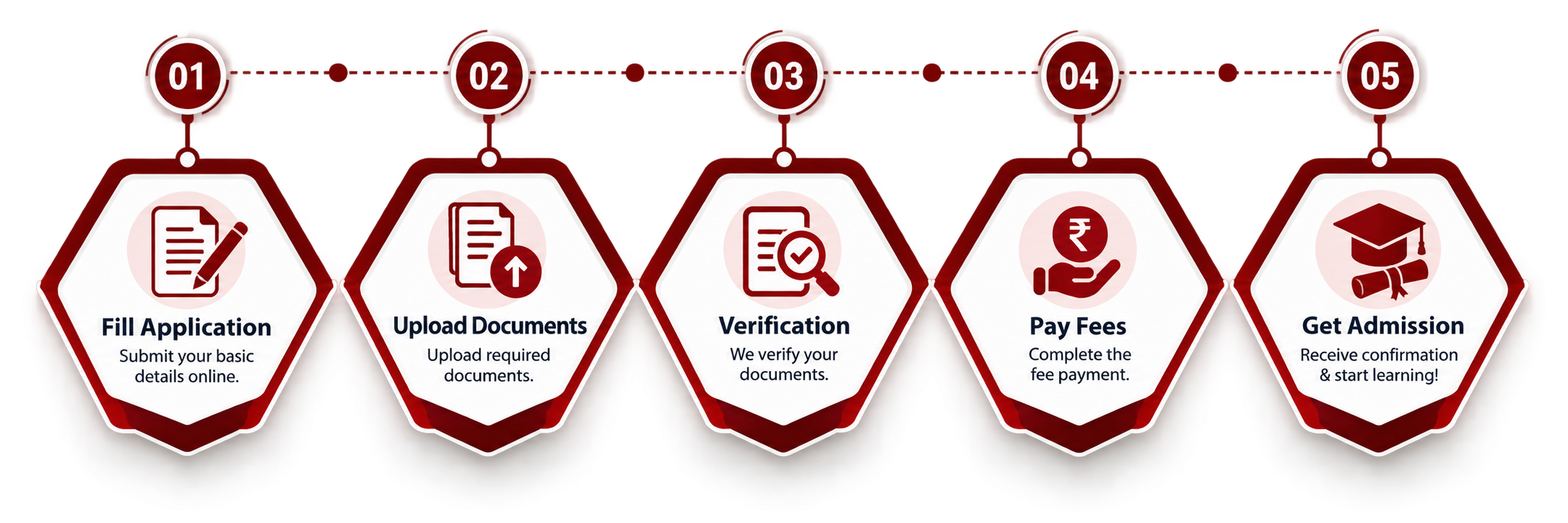
Check eligibility
Confirm you meet the qualifying-degree and marks requirement for the specific university and admission year.
- 2
Compare universities
Weigh entitlement status, total cost, specialisation availability and examination format side by side.
- 3
Select the programme
Choose the course and specialisation; some universities lock the specialisation at admission.
- 4
Submit the application
Register on the university's official admission portal and complete the application form.
- 5
Upload documents
Provide marksheets, certificates, identity proof and photographs for verification.
- 6
Complete admission
Pay the applicable instalment, receive the enrolment confirmation and LMS access.
How it works
- 1
Admission
You apply on the university's online admission portal, upload documents, and pay the first instalment once eligibility is confirmed.
- 2
Learning platform (LMS)
The university issues login credentials to its learning platform, where the semester's content, schedule and submissions live.
- 3
Live classes
Scheduled sessions with faculty, usually in the evening or on weekends, with doubt-clearing built in.
- 4
Recorded lectures
Every session is normally recorded so you can study around work hours and revise before assessments.
- 5
Assignments
Continuous assessment through assignments, quizzes and case work that counts toward internal marks.
- 6
Examinations
Term-end examinations in the format the university specifies — commonly online and proctored.
- 7
Project or capstone
Applied work in the final semesters, where the curriculum includes it.
- 8
Degree award
The university awards the degree on completion, with the same nomenclature it uses for the on-campus programme.
Specialisations
Specialisations published by the universities offering Online BCA. Each links to the universities that run it.
- Specialisation
Data Science
4 universities offer this
Amity Online · Uttaranchal University · Shoolini Online +1 more
Know more - Specialisation
Cloud Computing
4 universities offer this
Online Manipal · Shoolini Online · Parul University +1 more
Know more - Specialisation
Full-stack Development
2 universities offer this
Uttaranchal University · Parul University
Know more - Specialisation
Cloud and Security
1 university offer this
Amity Online
Know more - Specialisation
Data Engineering
1 university offer this
Amity Online
Know more - Specialisation
Software Engineering
1 university offer this
Amity Online
Know more
Curriculum
Semester 1
- Programming Fundamentals (C Language)Core
- Mathematics for ComputingCore
- Digital Electronics & Computer OrganisationCore
- Communication SkillsCore
- Programming LabCore
Semester 2
- Object-Oriented Programming (C++ / Python)Core
- Data StructuresCore
- Discrete MathematicsCore
- Operating SystemsCore
- Data Structures LabCore
Semester 3
- Database Management SystemsCore
- Computer NetworksCore
- Java ProgrammingCore
- Web Technologies (HTML, CSS, JavaScript)Core
- DBMS LabCore
Semester 4
- Software EngineeringCore
- Design and Analysis of AlgorithmsCore
- Server-Side Web DevelopmentCore
- ElectiveElective
- Web Development LabCore
Semester 5
- Specialisation Paper ISpecialisation
- Specialisation Paper IISpecialisation
- Mobile Application DevelopmentCore
- Cloud Computing FundamentalsCore
- Mini ProjectProject
Semester 6
- Specialisation Paper IIISpecialisation
- Cyber Security FundamentalsCore
- ElectiveElective
- Final-Semester Project / InternshipProject
This is a representative structure of how most three-year, six-semester Online BCA curricula are organised, from programming fundamentals through to a final-semester project. The actual subject names, credit weightage and sequence are set by each university and vary further by specialisation — check the syllabus published by the university you shortlist.
Learning & exams
Live classes
Interactive sessions with faculty on a published timetable.
Recorded lectures
On-demand access to every session for revision and schedule conflicts.
Digital LMS
One place for the syllabus, schedule, submissions, results and announcements.
Study material
E-books, reading lists, slides and case material issued by the university.
Discussion forums
Peer and faculty discussion threads, where the university enables them.
Assignments
Graded submissions spread across the semester.
Examinations
Term-end examinations in the mode the university specifies.
Practical papers are handled differently across universities: some provide access to cloud-based coding and database environments so you can run programs from any device, others release recorded lab demonstrations followed by an assessed take-home exercise, and a few require you to appear for a proctored practical examination. Ask specifically how labs and viva assessments work before enrolling.
Examination pattern
Internal assessment
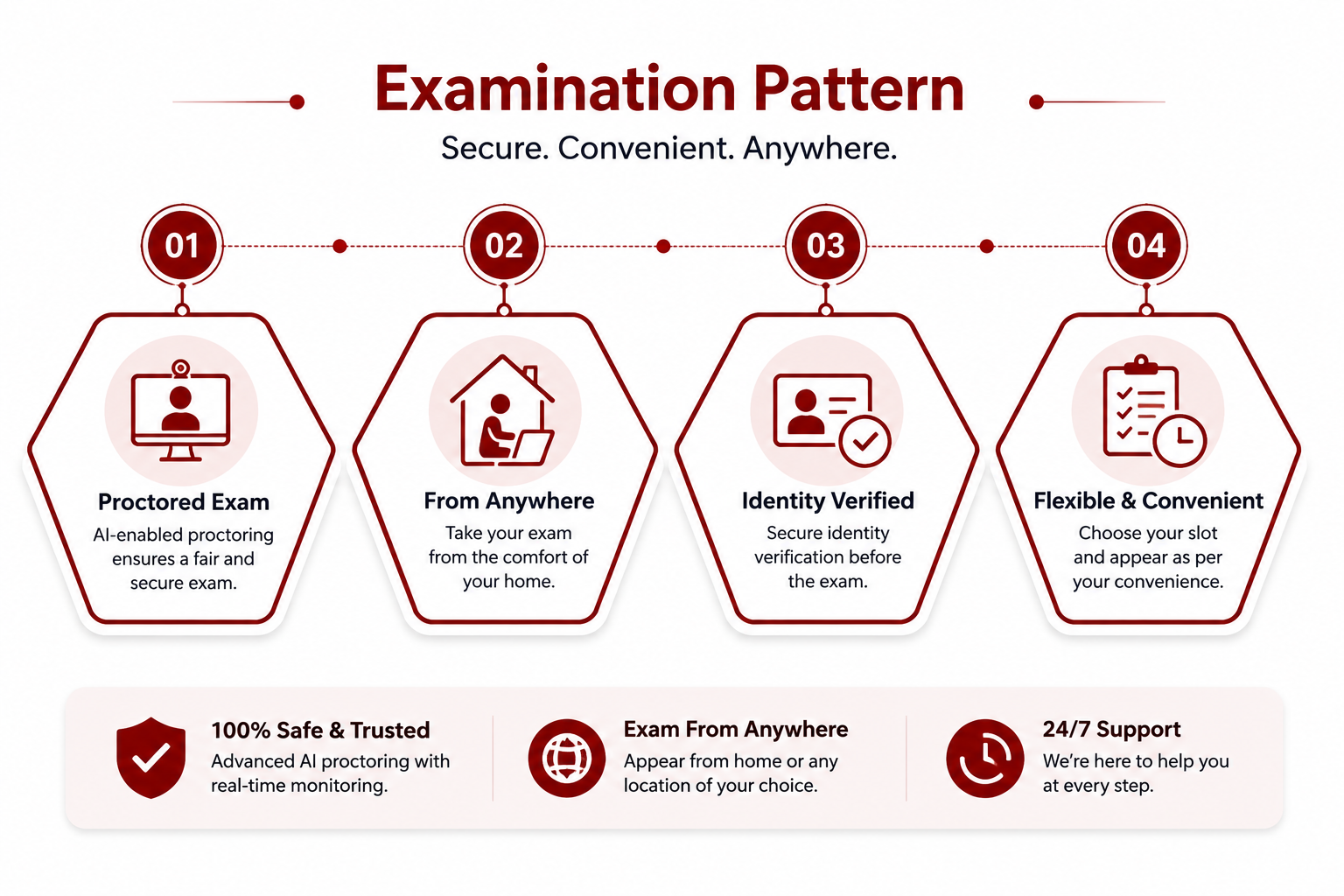
Assignments, quizzes and participation contribute to the internal component.
Term-end examination
End-of-semester examination covering the semester's subjects.
Examination mode
Commonly online and remotely proctored; a few universities use designated centres.
Projects and viva
Applied projects, and a viva where the curriculum includes one.
Passing criteria
Set by the university, usually as a minimum aggregate across internal and term-end components.
For BCA specifically, theory and practical papers are usually assessed separately, with the practical component evaluated through a coding assignment, a proctored lab test or a viva depending on the university. Weightings and formats can change between sessions, so confirm the current pattern with the university.
Career
Software Developer
Writes, tests and maintains application code as part of a development team.
Web Developer
Builds and maintains websites and web applications, front-end, back-end or both.
Junior Data Analyst
Cleans data and builds reports and dashboards that support business decisions.
System Administrator
Maintains servers, networks and access controls for an organisation's IT setup.
Quality Assurance / Test Engineer
Designs and runs test cases to catch defects before software ships.
Database Administrator (entry-level)
Supports database performance, backups and access under senior guidance.
Technical Support Engineer
Diagnoses and resolves software or infrastructure issues for end users.
Mobile App Developer
Builds applications for Android or iOS, often starting on a single platform.
IT Business Analyst
Bridges business requirements and technical teams for software projects.
Cyber Security Analyst (entry-level)
Monitors systems for threats and supports incident response under a senior analyst.
Industries and career areas
- Information technology
- IT-enabled services (ITES) and BPM
- E-commerce and retail technology
- Banking and financial services
- EdTech
- Telecom
- Healthcare technology
- Government and public-sector IT
- Start-ups and product companies
- Consulting
Salary
- Years and relevance of prior work experience
- The university and programme you complete
- Specialisation and the skills you can demonstrate
- City and cost-of-living band of the role
- Industry and company size
- Whether you are switching function or progressing in the same one
We do not publish Online BCA salary figures we cannot attribute to a credible, dated source. Starting pay depends heavily on demonstrable coding skills, internships, the specific role and city, and the hiring company — not on the study mode alone.
Placement support

Placement assistance
Access to a job board or referrals, where the university operates one for online learners.
Resume support
Guidance on positioning experience and coursework for target roles.
Mock interviews
Practice interviews and feedback, where offered.
Career counselling
One-to-one guidance on role and specialisation choices.
Industry sessions
Guest lectures, webinars and networking events.
Internship support
Assistance for learners without work experience, where the university runs it.
Placement assistance is not the same as guaranteed placement. For a technical degree like BCA, ask specifically whether the university's career support includes coding-interview preparation and whether recruiters hiring for the online programme are IT-focused.
Validity
Whether a specific Online BCA is valid depends on the university and on the regulatory entitlement or approval that applies to that programme for your admission period. It is not a property of "online study" in general.
Check the status for the exact programme, the exact university and the exact academic year you are joining — entitlements are granted for defined periods and can change between cycles.
Where a professional body or an employer sets its own recognition rule, verify against that rule as well before you pay any fee.
How to verify before you pay
- UGC entitlement or status for the online programme
- Any other regulatory approval applicable to the course
- Accreditation held by the university
- University identity — full legal name, not a study-centre brand
- The programme is actually listed for the current session
- Status covers the academic year you are joining
- Every claim confirmed on the official university website
- Complete, written fee structure including all additional charges
- Published examination and assessment structure
Advantages & limitations
Advantages
- Study on a flexible schedule with recorded sessions
- Continue earning while you study, avoiding a career break
- Lower opportunity cost than leaving a job for a campus programme
- Access to universities in other states without relocating
- Multiple specialisations available in a single degree structure
- Course material, submissions and results in one digital platform
Limitations
- Limited in-person campus interaction
- Requires self-discipline and consistent weekly time
- Networking works differently from a full-time campus cohort
- Programme quality and student support vary widely between universities
- Placement support is assistance, not a guarantee
- A few employers still evaluate campus and online programmes differently
Is it worth it
It can be worth it when
- You want a formal computing degree while building real coding practice through labs and projects
- The university and programme carry the recognition your employer or a postgraduate course requires
- The specialisation on offer matches the IT role you are targeting
- You can commit consistent weekly hours to both theory and hands-on practice
- You plan to pursue an MCA or a related postgraduate qualification afterwards
It may not suit you if
- You expect the degree alone, without a coding portfolio, to secure a developer role
- You are choosing purely on the lowest advertised fee without checking how labs are run
- You need in-person mentorship and pair-programming to learn effectively
- Your target employers specifically prefer full-time, on-campus computer-science graduates
- You cannot access a reasonably capable computer and stable internet for coding practice
Online BCA vs regular
| Factor | Online BCA | Regular BCA |
|---|---|---|
| Mode | Online delivery | On-campus |
| Flexibility | High — recorded sessions | Lower — fixed timetable |
| Working while studying | Designed for it | Difficult in full-time programmes |
| Campus experience | Limited | Central to the programme |
| Networking | Largely digital | In-person cohort and clubs |
| Cost | University dependent | University dependent |
| Admission | University specific | University specific, often entrance-led |
| Best suited to | Professionals needing flexibility | Learners wanting a full-time campus experience |
Online BCA vs distance
| Factor | Online BCA | Distance BCA |
|---|---|---|
| Learning mode | Structured digital delivery through an LMS | Self-study with printed or downloadable material |
| Live classes | Scheduled live sessions in most programmes | Limited; contact sessions where offered |
| Recorded content | Generally available | Not standard |
| Interaction | Faculty and peer interaction online | Mostly independent |
| Examinations | Often online and proctored | Frequently centre-based |
| Flexibility | High, with a semester rhythm | Highest, with least structure |
| Student support | Dedicated online support in most programmes | Varies widely |
| Rules | University and programme specific | University and programme specific |
How to choose
Verify recognition first
Confirm entitlement and approval status for the exact programme and year before comparing anything else.
Compare total cost, not the headline fee
Add registration, examination, study material and technology charges to the tuition figure.
Read the syllabus
Check that the subject list matches the role you are targeting, not just the degree name.
Check specialisation availability
Confirm the specialisation you want is running this session, and whether you can change it later.
Test the learning platform
Ask for a demo of the LMS, session schedule and how recordings are released.
Understand the examination structure
Know the mode, proctoring rules, re-attempt policy and passing criteria.
Ask about student support
Response times, academic mentors and escalation paths matter over a two- or three-year programme.
Check career support in writing
Ask what the career service actually provides for online learners.
Review refund and cancellation terms
Know what happens if you withdraw after the session starts.
Confirm on the official source
Take the final decision from the university's own website and admission notification.
Why compare Online BCA here
University comparison
Side-by-side comparison of every Online BCA programme in our dataset.
Transparent fees
Published figures only, manually researched — never estimated.
Research-based information
Fee and approval details are researched from what each university publishes.
Admission guidance
Free counselling to shortlist a university that fits your goal and budget.
How to compare universities for this course
An Online BCA introduces undergraduate learners to computer applications, programming, databases, systems and software development. Students should compare the actual technical curriculum, practical/project work and learning support rather than choosing only on course title.
What to compare
- awarding university and mode
- current verified total cost
- eligibility and prerequisites
- duration and academic structure
- curriculum and projects
- specialisations/electives
- examination/proctoring
- academic and career support
- scholarships where officially published
Fees guidance
There is no single universal fee for Online BCA. The directory below should pull the current programme fee from each university-course record and show “Not published” where the official amount is not currently verified.
Curriculum guidance
Common technology concepts can be explained at course level, but the actual semester syllabus must remain university-specific. Use the programme records below for the authoritative subject lists.
Admission guidance
Admission requirements and dates can differ by university and session. Use the exact programme page for the current application cycle, documents and selection rules.
Examination guidance
Do not assume one exam model applies to every university. Show the documented assessment/proctoring pattern from the university research layer.
Career guidance
Career outcomes from Online BCA depend on the learner's skills, experience and target role. Use role families as guidance rather than salary or placement guarantees.
9 universities in the researched 2026-27 dataset list this course.
Reviews
Student reviews will appear here as verified feedback becomes available. We do not publish testimonials we could not trace to a named learner.
Studied online? Write a review
Share your experience of fees, faculty, LMS and exams. Your review is published straight away so other students can read it.
Online BCA FAQs
It is the Bachelor of Computer Applications studied through a university's online mode, with digital classes, study material, lab work and university-specified examinations. The degree is awarded by the university itself.
Validity depends on the university and on the regulatory entitlement or approval that applies to that specific programme for your admission period. Verify the status for the exact university, programme and academic year before enrolling.
Recognition is programme-specific, not universal. Check the university's UGC entitlement status for the online mode, for the BCA specifically, and for your admission year, on the official source.
Three years across six semesters in most programmes. Some universities publish a maximum permissible duration that allows you to complete over a longer period.
A pass in 10+2 from a recognised board is the common requirement. Whether Mathematics or Computer Science must have been studied at 10+2 varies by university, so check this specifically before applying.
It depends on the university. Some require Mathematics or Computer Science as a 10+2 subject, while others accept any stream, sometimes with a bridge paper in the early semesters.
Fees are set by each university, so the range is wide. The university comparison on this page shows the published figure for each programme in our dataset, and marks anything we could not verify as "Not specified".
Approaches vary: cloud-based coding or database environments accessible from any device, recorded lab demonstrations followed by an assessed exercise, or a proctored practical examination and viva. Confirm the exact method with the university before enrolling.
Most universities use online, remotely proctored term-end examinations for theory papers, with practical papers assessed separately through a coding test, lab exercise or viva. A few universities use designated centres. Confirm the mode with the university.
Yes — the format is built for it, with recorded lectures and semester-based assessment. Set aside consistent time each week for coding practice, since this subject is learned by doing, not only by reading.
Choose based on the role you want next rather than the trend. The specialisation guide on this page maps common goals — such as data roles, cloud, security or full-stack development — to the specialisations that support them.
Yes, a BCA is a common and directly relevant qualifying degree for an MCA or an M.Sc in computer science, subject to the admitting institution's own eligibility and minimum-marks rules.
Yes, a BCA can meet the graduate-level eligibility for many government and public-sector-undertaking positions, and for IT-specific government roles where a computing background is asked for. Always check the specific notification's eligibility clause.
Common entry points include software development, web development, technical support, quality assurance, database administration and junior data or business analyst roles. Outcomes depend on demonstrable coding skills as well as the degree.
Yes. For technical hiring, employers commonly look at projects, code samples or a GitHub profile alongside the degree. Building a small portfolio during the programme, especially around the final-semester project, materially helps your job search.
It varies by role, city, company and — most of all — demonstrable coding ability and any internship experience. We deliberately do not publish a single national average, since such figures are rarely sourced or comparable.
The degree nomenclature is the same when the programme carries the applicable entitlement. The experience differs: campus programmes offer in-person labs and a resident cohort, online programmes offer flexibility and continuity of work or other commitments.
No. Universities offer placement assistance — job boards, resume help, mock interviews, recruiter sessions — which is different from a placement guarantee. Be sceptical of any guarantee claim.
Some universities accept an equivalent diploma in place of 10+2 for BCA admission, subject to their own equivalence rules. Confirm this directly with the university before applying.
Online BCA guides & articles
University-published research and guides relevant to Online BCA.


Amity Online BCA 2026
Syllabus, Fees, Eligibility & Careers
Amity Online BCA 2026: Syllabus, Fees, Eligibility & Careers
Amity Online BCA 2026 guide — semester-wise syllabus, ₹29,200 per semester fee reference, eligibility, admission steps, specialisation tracks, career support and IT job roles.
16 Aug 2026 15 min
Read guide Amity Online Courses & Fees 2026-27
Complete Guide
Amity Online Courses & Fees 2026-27: Complete Guide
Full breakdown of Amity University Online courses and fees 2026-27 across MBA, BCA, BBA, BCom, BA and MCA, including partnered programmes.
14 Aug 2026 15 min
Read guide Amity Online Placements & Career Outcomes Explained
Amity Online Placements & Career Outcomes Explained
How Amity University Online's placement support, hiring partners and career services actually translate into job outcomes for online learners.
14 Aug 2026 13 min
Read guide 
CU Online BCA 2026-27
Fees, Syllabus, Maths Rule & Careers
CU Online BCA 2026-27: Fees, Syllabus, Maths Rule & Careers
Chandigarh University Online BCA explained — Mathematics not mandatory, ₹1,77,000 fee with early-bird figure, six-semester syllabus and five specialisations.
17 Aug 2026 16 min
Read guide Chandigarh University Online Courses & Fees 2026-27 Guide
Chandigarh University Online Courses & Fees 2026-27 Guide
Complete breakdown of Chandigarh University Online BBA, BCA, MBA and MCA fees, specialisations, EMI and scholarships for 2026-27.
14 Aug 2026 15 min
Read guide 
LPU Online BCA 2026
Full 6-Semester Syllabus With Course Codes
LPU Online BCA 2026: Full 6-Semester Syllabus With Course Codes
The complete LPU Online BCA syllabus down to course codes for all six semesters, including the discipline-specific electives in years 5 and 6, plus what to build after BCA.
18 Aug 2026 13 min
Read guide Not sure which BCA fits you?
Get a free shortlist based on your budget, work schedule and career goal — no cost, no obligation.

Not sure which Online BCA to pick?
Compare the universities above on fee, entitlement status and specialisation, or talk to a counsellor who will walk you through the shortlist. No cost, no obligation.